


How to Use Drones on Construction Sites
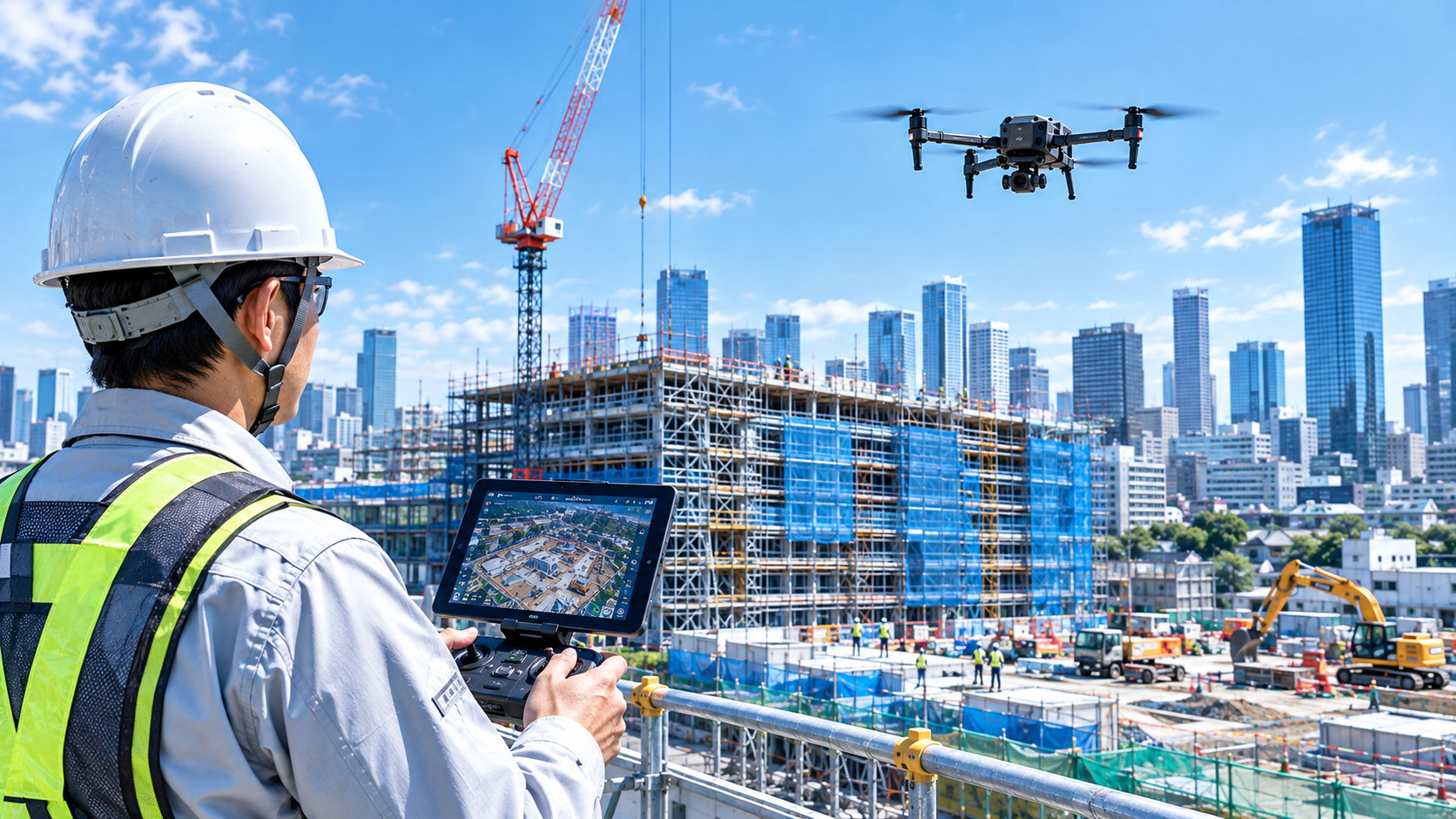
Ideal for high-altitude inspections and surveys
On construction sites, there are many situations where high-altitude conditions need to be checked, such as inspecting the condition of roofs and exterior walls, or conducting site surveys prior to construction work.
In such inspections and surveys, workers traditionally have to climb to high places directly, or use aerial work platforms and scaffolding. However, utilizing drones enables pre-inspection condition checks at heights and efficient verification over a wide area.
Drones are particularly useful in situations where you want to first check the condition of high places or get a complete overview of the work site.
This article introduces examples of drone applications on construction sites, their benefits, and important points to keep in mind when using them.
Table of Contents
- Main applications on construction sites
- Benefits of Using Drones
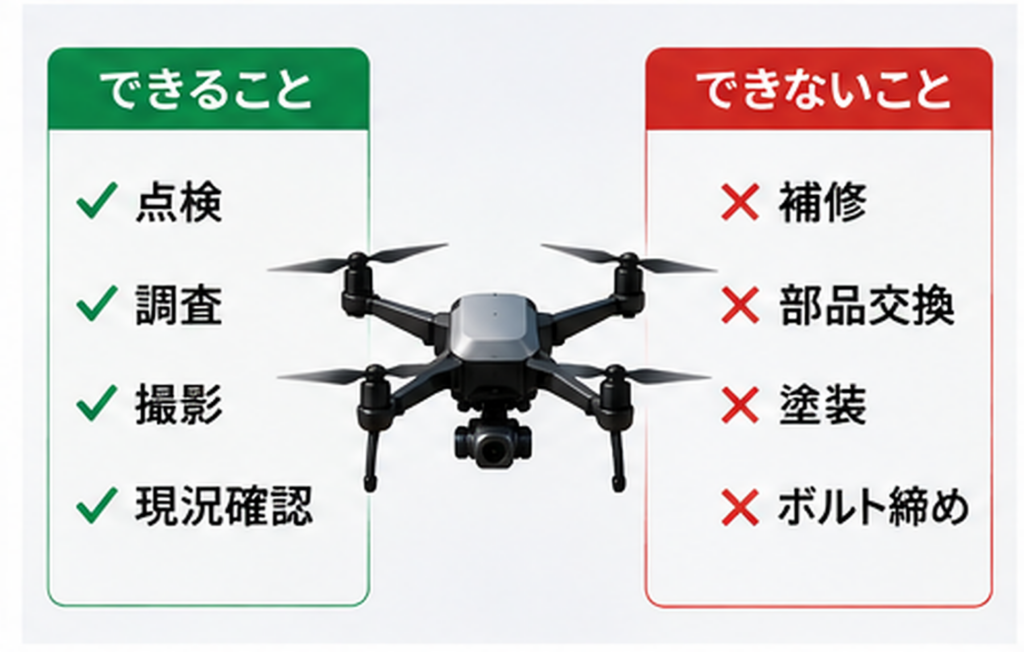
- What Drones Are Good and Not Good At
- Inspect with drones and proceed to the necessary work
- Flight rules to know before using drones
- For first-time users, renting is also a great option to try it out.
- Summary
Main applications on construction sites
Drones are tools equipped with cameras, sensors, and other devices that allow users to assess conditions on-site from the air or in areas that are difficult for people to access.
While drones were once primarily associated with aerial photography, they are now also used at construction sites for inspections, surveys, and documenting construction work.
[Key Examples of Use at Construction Sites]
| Inspection of the Roof and Exterior Walls | For inspecting conditions at heights, such as damage to roofing materials or the condition of exterior walls. |
| Field Survey | For assessing the current condition prior to construction and gaining an overview of the entire site. |
| Checking and Recording Construction Progress | For checking the status of construction projects, keeping records, and preparing reports. |
| Assessing the Situation After a Disaster | For assessing conditions in areas that are difficult for people to access immediately. |
Benefits of Using Drones
When inspecting the condition of high places, such as roofs and exterior walls, methods include having people climb up to those locations directly or using aerial work platforms or scaffolding.
Drones really come into their own when it comes to "assessing the condition" before starting repairs or construction work.
For example,
・I want to check for potential sources of roof leaks
・I want to check if the roofing material is damaged
・I want to check the condition of the exterior walls
・I want to check the condition of the solar panels
These are examples of such cases.
By using drones, it is possible to assess a situation before sending people up to high places or to capture footage of a wide area in a short amount of time. In some cases, inspection tasks that previously required multiple people can now be handled by a smaller team.
■Benefits of Using Drones for Inspections and Surveys at Heights■
Benefit #1
Can be checked before a person climbs to a high place
Before people approach a hazardous area, they can check the conditions at the site at
Benefit #2
Allows you to check a wide area in a short amount of time
You can efficiently photograph and inspect large areas, such as roofs and exterior walls, at
Benefit 3
There are cases that can be handled by a small team.
Depending on the scope of the inspection and on-site conditions, it may be possible to handle the work with fewer personnel than in the past
Benefit ④
This will serve as a basis for determining the next steps
By analyzing the video and images you've captured, you can assess the situation and
then determine the necessary investigations and repair methods.
The role of drones isn't just to take pictures from high up.
At the "Observe and Investigate" stage, we assess the situation and determine how to proceed.
That is where the major benefits of using drones at construction sites lie.
What Drones Are Good and Not Good At
Drones are very effective for inspections and surveys, but there are some situations where they are not suitable.
(1) Actual construction and repairs
Drones cannot perform tasks that require direct human intervention, such as tightening bolts, replacing parts, cleaning, or making repairs.
② Investigations that require physical contact with the subject
It is not suitable for inspections that involve physically touching the subject, such as tapping inspections.
③ During strong winds or rainy weather
Winds can be stronger at higher altitudes than at ground level. Depending on weather conditions such as wind and rain, it may not be safe to fly.
④ Tight spaces or indoors
With outdoor drones, there may be situations where they are difficult to use depending on the flight space or GPS conditions.
For indoor flight, you need to choose a drone that is suitable for indoor use.
Inspect with drones and proceed to the necessary work
If, after inspecting the site with a drone, we determine that repairs or replacements are necessary, we will next consider the actual method for carrying out the work.
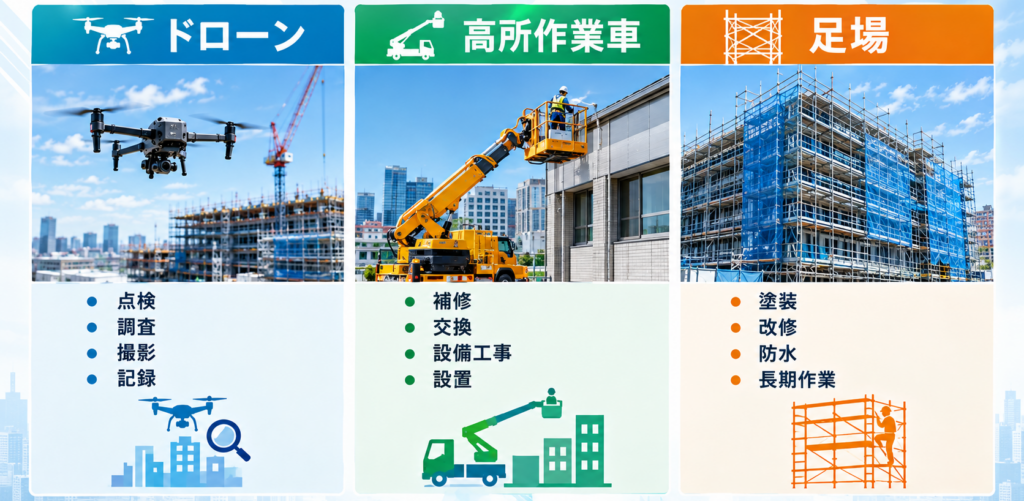
The appropriate method varies depending on the nature and duration of the work—for example, an aerial work platform is used for short-term work at heights, while scaffolding is used for continuous work covering a wide area.
Inspections and Surveys Using Drones
↓
Assessing Site Conditions
↓
Determining Necessary Work and Methods
↓
Construction and Repairs Using Aerial Work Platforms and Scaffolding
To summarize their respective roles, they are as follows:
Drone
●Role: Inspection, Investigation, and Verification
Roof Inspection / Exterior Wall Inspection / On-Site Survey / Construction Progress Check / Disaster Assessment
●Features
・Ideal for monitoring conditions at high elevations or over wide areas
・Can be used for preliminary inspections before personnel climb to high elevations
Aerial Work Platform
●Role: Short-term, part-time work at heights
Lighting Replacement / Sign Installation / Equipment Installation / Repairs / Maintenance
● Features
・Allows people to move to high places and perform work there
・Suitable for relatively short-term work at heights
Scaffold
● Role: Long-term, ongoing work at heights
Painting / Exterior Wall Renovation / Waterproofing / Major Renovation
● Features
・Suitable for long-term operations
・Capable of continuous operation over a wide area
"Are you going up to a high place to check something," or "Are you going up to a high place to do some work?"
By first clarifying your objectives, you’ll be able to identify situations where drones can be put to use.
Flight rules to know before using drones
You can't fly drones just anywhere.
In Japan, drones weighing 100 grams or more are classified as “unmanned aircraft” under the Civil Aviation Act and must be registered.
In addition, depending on where and how you fly, you may need to obtain permits or approvals, or take measures to ensure safety.
There are national certifications for drone pilots—First-Class and Second-Class Unmanned Aircraft Pilots—but this does not mean that you cannot fly a drone at all without holding one of these certifications.
What matters isn't just whether you have a qualification or not, but
・Where will you be flying?
・How will you be flying?
・Have you completed the necessary procedures?
is to check this in advance.
[Checklist: Things to Check Before Flying]
□ Are there any restrictions on the flight location?
□ Is it necessary to check with the landowner or facility manager?
□ Are there any third parties in the vicinity?
□ Are there any obstacles, such as buildings or power lines?
□ Are the weather conditions, such as wind and rain, suitable?
□ Have you confirmed the flight path and emergency procedures?
□ Have you performed a pre-flight inspection of the drone?
In addition, local governments and facility managers may have their own rules for parks, riverbanks, and public facilities.
When actually flying, you must check the latest information published by the Ministry of Land, Infrastructure, Transport and Tourism and other relevant agencies, and take appropriate measures based on on-site conditions.
For first-time users, renting is also a great option to try it out.
"I'm not sure if this will actually be useful in our company's work environment."
"I'm interested, but it's hard to just go ahead and buy it right away."
In cases like that, why not try renting one first?
At Act One Yamaiichi, we offer two rental options tailored to our customers' experience levels and intended use.
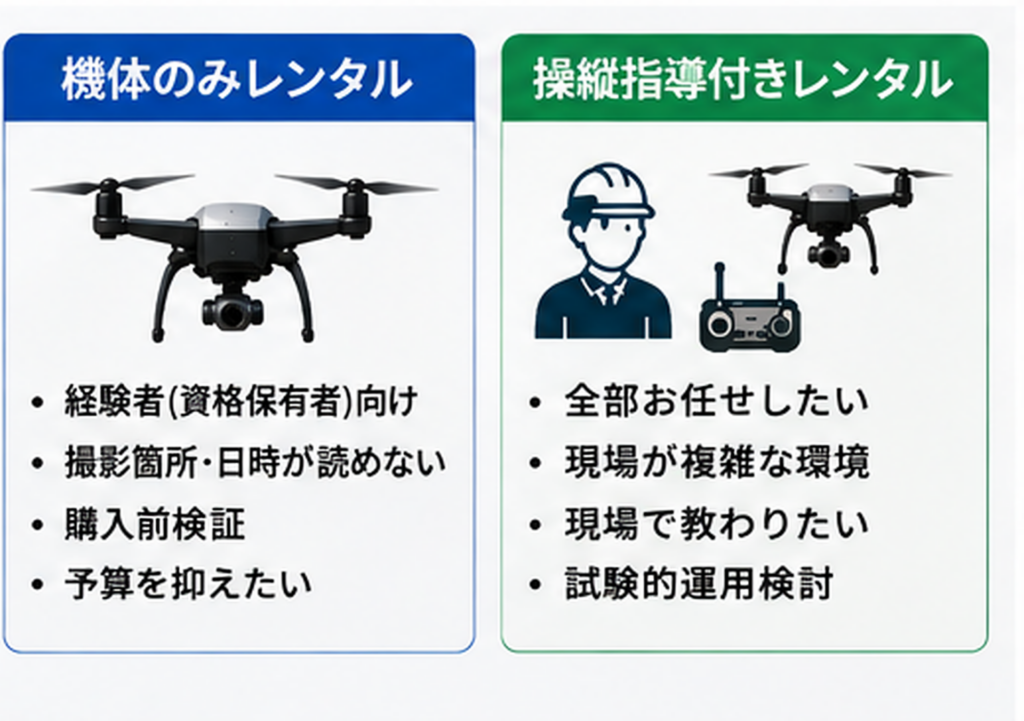
In addition to rentals, we can also provide implementation support based on real-world scenarios.
You can view the drones available for rent from our company here.
Drone Lineup | Act One Yamaiichi: Your Source for Construction Temporary Equipment Rentals
Summary
A major advantage of drones in high-altitude inspections and surveys is their ability to assess the situation before people have to climb to high places and to efficiently survey large areas.
On the other hand, there are some tasks—such as actual repairs and construction work—that cannot be handled by drones alone. By first using drones to assess site conditions and then determining the appropriate work methods—such as aerial work platforms or scaffolding—based on those findings, we can respond to on-site needs by leveraging the strengths of each approach.
"I want to check the conditions at a high elevation first." "I want to get a sense of the situation over a wide area."
In situations like that, why not consider using drones as one of your options?
At Act One Yamaiichi, in addition to renting the aircraft alone, we also offer rentals that include flight instruction (rentals with an operator).
If this is your first time using a drone, please feel free to contact us.
Reference Information
[Ministry of Land, Infrastructure, Transport and Tourism]
・Rules for Flying Unmanned Aircraft (Drones, Radio-Controlled Aircraft, etc.)
・No-Fly Zones for Unmanned Aircraft and Flight Procedures
*Please note that laws and regulations are subject to change. Be sure to check the latest official information before flying.