


The Latest Trends in Construction DX: Explaining AI Applications and Safety Management Case Studies

In the construction industry, addressing labor shortages, ensuring safety, and improving operational efficiency simultaneously have become more critical than ever. In response to these challenges, Construction DX (Digital Transformation) is gaining significant attention.
Until recently, Construction DX primarily focused on digitization, such as digitizing drawings and documents or moving them to the cloud.
However, the industry has now advanced beyond that stage, and there is a growing trend toward transforming job site management by leveraging AI and various types of data.
In fact, the Ministry of Land, Infrastructure, Transport and Tourism (MLIT) has introduced " i-Construction 2.0 ," which sets forth three pillars: Automation of Construction, Automation of Data Linking, and Automation of Construction Management. Through these initiatives, the ministry aims to achieve at least a 30% reduction in labor requirements and a 1.5-fold increase in productivity at construction sites by fiscal year 2040. Construction DX is no longer an effort limited to a handful of companies; it has become the direction for the entire industry.
Based on these latest trends, this article provides an easy-to-understand introduction to how AI utilization is expanding through Construction DX, along with practical examples applied to safety management, which is highly relevant to everyday site operations.
The Growing Focus on Construction DX
In the construction industry, amid labor shortages and the challenges of passing on technical skills, there is an urgent need to manage job sites safely and efficiently with a limited number of personnel. Because it has become difficult to simultaneously improve quality, safety, and productivity using traditional methods alone, there is a growing necessity to fundamentally review site operations.
Consequently, construction DX is positioned not merely as the introduction of IT, but as an initiative to rethink operations, organizations, processes, and even ways of working. The Ministry of Land, Infrastructure, Transport and Tourism (MLIT) has also outlined a direction toward using AI and various systems to automate parts of the processes that human workers have traditionally handled manually, allowing personnel to shift focus toward more managerial and supervisory tasks.
i-Construction 2.0 Behind the Latest Trends
To understand the latest trends in construction DX, the Ministry of Land, Infrastructure, Transport and Tourism's (MLIT) i-Construction 2.0 initiative is indispensable.
Anticipating future population decline, this initiative aims to realize construction sites where a small number of people can work safely and comfortably. What is particularly noteworthy is the concept of transforming on-site construction, management, and data linking into an integrated system, rather than simply increasing the amount of ICT equipment.
For instance, the documentation outlines a direction where a single worker can manage multiple pieces of construction machinery by leveraging AI and systems. It also highlights the expansion of remote construction technologies and labor-saving inspection methods through image analysis. A major characteristic of modern Construction DX is that digital technology is no longer positioned as a tool for record-keeping, but rather as a mechanism to support on-site judgment and operations.
Three Directions for AI Utilization in Construction DX
1. Information organization and decision-making support
In the construction industry, a significant amount of time is spent prior to making decisions—such as reviewing technical documents, referencing past case studies, searching internal knowledge bases, and creating comparative analysis materials. By utilizing AI, companies are streamlining this information organization, creating an environment where workers can access the necessary data much faster.
The use of generative AI, in particular, is highly compatible with this area—not just for generating text from scratch, but as a support tool to organize information and synthesize it into a format that facilitates easy decision-making. In the construction industry, where information is frequently exchanged between job sites, headquarters, and subcontractors, the value of this type of support is expected to grow even further.
2. Automation of construction and management
On construction sites, labor-saving in both physical work and management tasks is advancing through the use of AI, image analysis, and remote technologies. Official documents from the Ministry of Land, Infrastructure, Transport and Tourism (MLIT) also highlight the automation of construction, remote operations, schedule adjustments utilizing construction data, and rebar inspection via image analysis. This makes the automation and streamlining of construction management a definitive trend.
Ultimately, the goal of construction DX is not simply to reduce headcount, but to build a system that allows job sites to be operated efficiently while maintaining safety and quality, even with limited personnel.
3. Visualization and early response in safety management
At construction sites, how quickly one can detect signs of an abnormal condition is critical. When it comes to accidents or workers’ sudden illnesses, responding after they happen is too late; a system is required that does not overlook initial, subtle irregularities. wrong are not overlooked.
For this reason, initiatives are currently underway to capture signs of danger and changes in conditions by leveraging AI cameras, various sensors, and image analysis technology. In the field of safety management as well, Construction DX is evolving from improving the efficiency of record-keeping to supporting status checks.
Why DX Is Crucial in Safety Management Today
On construction sites, various safety checks are conducted daily. However, on busier sites, these checks can easily become a mere formality or become overly dependent on individual experience and personal differences.
This is precisely why it is vital to establish a structured system that reduces oversights and makes it easier for anyone to maintain a consistent standard of safety management.
In recent years, countermeasures against hot and humid conditions have become a particularly high priority. Regarding heatstroke risks, workers might push themselves too hard, or those around them may fail to notice the subtle signs of their deteriorating condition. In short, the problem is not just that the danger exists, but also the difficulty of detecting it early.
As a result, systems that visualize heat risks—making it easier to prompt immediate responses such as checking in on workers, enforcing breaks, or adjusting personnel allocation—have become a highly suitable concrete application area for DX.
This has driven a growing interest in tools that can visualize heat risks to facilitate these rapid, early-stage actions.
Construction DX: Accessible Heat-Stroke Prevention Measures and "Kaokara"
When hearing the term "Construction DX," some might imagine the introduction of large-scale systems. In reality, however, there are many initiatives that can be started with familiar, everyday challenges occurring on-site. One typical example is the visualization of heat-stroke prevention measures.
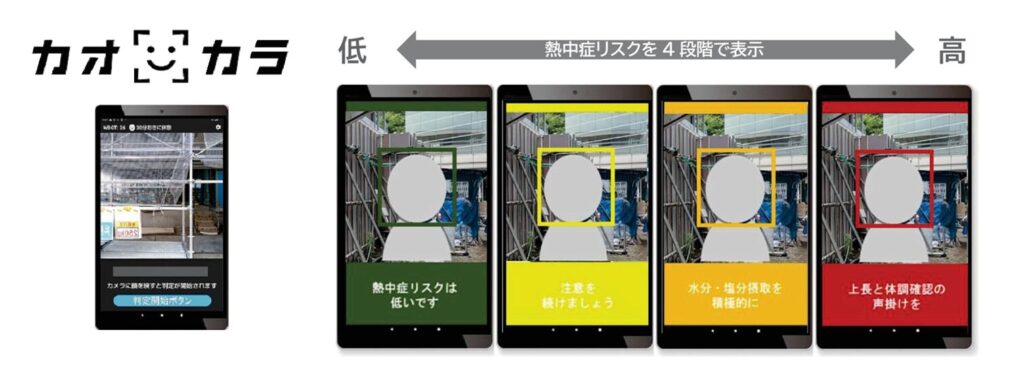
"Kaokara," a product available as a rental product, is an AI-powered camera designed specifically for this purpose. It analyzes subtle facial changes using AI and pairs this with location-based WBGT (Wet Bulb Globe Temperature) data via GPS. In just about three seconds, the device displays an estimated risk level of heatstroke across four distinct stages.
On busy construction sites, even when everyone knows heat safety matters, monitoring health conditions can easily take a back seat. Workers tend to push themselves too hard, and managers can find it difficult to keep an eye on team members working at a distance. KaoKara solves this by acting as an early warning system to trigger immediate awareness.
Please note that Kaokara is not a medical device meant for diagnosing, treating, or preventing heatstroke; it is strictly a tool to support on-site decision-making. Ultimately, the technology shouldn't make the final call, and its true value lies in prompting practical steps on the ground, making it easier for teams to check in on one another, call for breaks, or reassign tasks.
Summary
The trend of Construction DX is expanding beyond simple digitization into AI-driven decision support, safety management, and automation. Among these advancements, heat safety is an immediate, high-priority challenge on the ground, making it the perfect entry point for companies looking to take their first step into DX.
Kaokara offers a practical solution tailored specifically to these on-site challenges. Instead of viewing Construction DX as something overly complex, why not start with tools that are useful in day-to-day on-site operations?
If you are looking to strengthen your heat safety measures with an easy-to-use safety management tool, please visit the Kaokara product page to learn more.
Reference materials
- Ministry of Land, Infrastructure, Transport and Tourism: i-Construction 2.0
- Ministry of Land, Infrastructure, Transport and Tourism: i-Construction 2.0 - Automation of Construction Sites (PDF)
https://www.mlit.go.jp/tec/constplan/content/001738240.pdf